
WELCOME BONUS 300%
UP TO €2000 + 100
FREE SPINS
UP TO €2000 + 100
FREE SPINS
Home → Roulette
Roulette at Goldzino
Which Bets are Excluded from Bonus Wager?
Certain roulette bets do not contribute to the wagering requirements of the 300% welcome bonus up to €2,000. Specifically, inner bets on French Roulette variants, where the La Partage rule does not apply, are excluded. This means bets like Straight, Split, Street, and Corner wagers on these tables will not count towards clearing the bonus.
The bonus terms stipulate that only 10% of wagers placed on table games contribute to the bonus turnover. This is a lower contribution rate compared to other game types, implying that players will need to place significantly more bets on table games to meet the wagering requirements.
For example, a €10 bet on a table game at 10% contribution counts as €1 towards the €4,000 turnover requirement set by a 40x wagering multiplier on a €100 bonus. Bets excluded from bonus wager calculation, such as the aforementioned inner bets on certain French Roulette variants, will not reduce this €4,000 target.
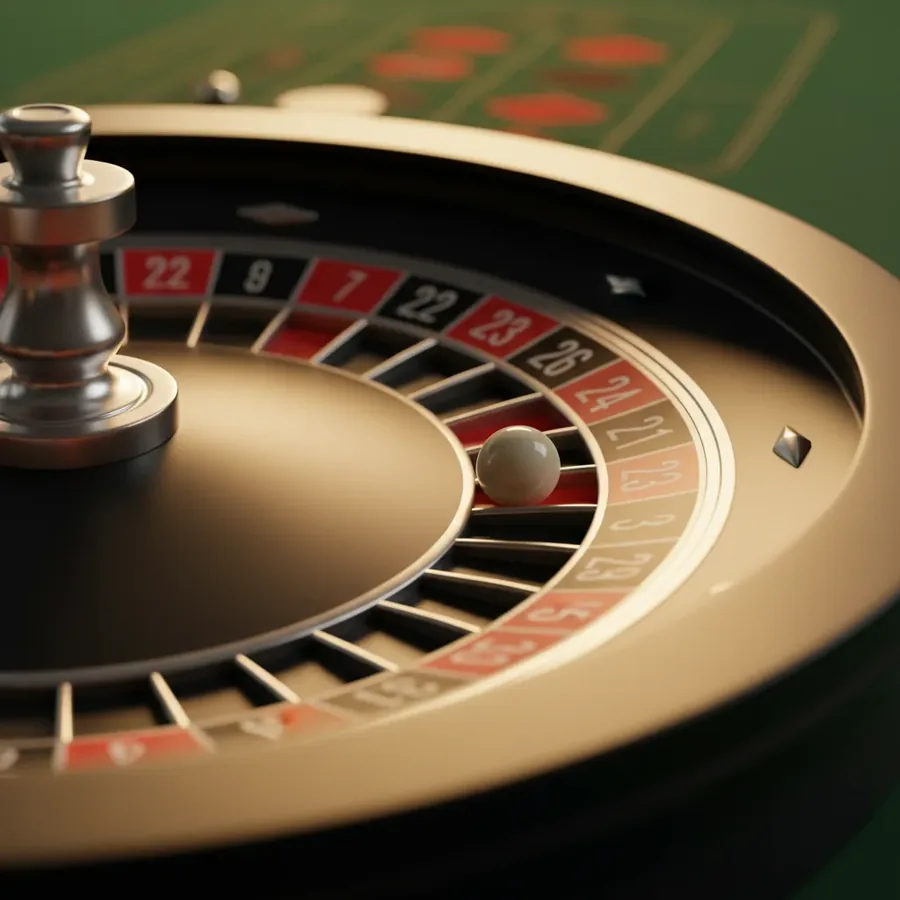
Why the Ball Has No Memory
Roulette outcomes are determined by chance, and each spin is an independent event. The ball has no memory of previous results, meaning a streak of losses does not influence future probabilities. This is fundamental to understanding the game's nature, regardless of whether it is European or American Roulette.
For instance, the European Roulette wheel, with its 37 sectors, has a house edge of 2.70%. This edge remains constant for all bets, including even-money bets like Red/Black. The RTP for European Roulette is 97.30%, reflecting this consistent mathematical advantage over the long term.
Similarly, American Roulette, featuring 38 sectors due to the inclusion of '00', presents a higher house edge of 5.26%. The RTP for American Roulette stands at 94.74%. This disparity underscores the importance of understanding the specific wheel mechanics at play, as the ball's behavior is always random.
Straight 35:1 vs Dozen 2:1 Hit Rate
The 'Straight' bet in European Roulette pays 35:1 but covers only one number out of 37, resulting in a lower hit rate. In contrast, a 'Dozen' bet pays 2:1 and covers 12 numbers, offering a significantly higher probability of winning on any given spin.
With a 37-sector European wheel, the probability of a Straight bet winning is 1/37, while a Dozen bet has a 12/37 chance of success. This difference in coverage directly impacts how frequently players can expect to see a return on their wager.
The RTP for both Straight and Dozen bets on a standard European wheel remains 97.30%. Despite the difference in hit rate and payout, the long-term theoretical return to player is the same, as the house edge of 2.70% is factored into all wagers.
Losing Streaks: 10 Times Red Is Normal
In games like roulette, encountering a streak of identical outcomes, such as 10 consecutive 'Red' results, is statistically normal. Each spin is an independent event, and the probability of 'Red' or 'Black' on a European wheel remains 18/37, irrespective of past results.
The house edge on European Roulette is 2.70%, with an RTP of 97.30%. This means that over a vast number of spins, the casino expects to retain 2.70% of all bets placed. Short-term deviations, like a long streak of red, do not alter this fundamental probability.
For example, the probability of hitting 'Red' ten times in a row on a European wheel is (18/37)^10, a low probability but one that will occur periodically over millions of spins. The 'La Partage' rule on French Roulette, however, can mitigate losses on even-money bets when the ball lands on zero.
Max Bet Per Number vs. Max Bet Per Round
Online casinos typically set maximum bet limits to manage risk, distinguishing between the maximum wager allowed on a single number and the total maximum bet for an entire round. For instance, a table might have a €5,000 maximum bet per round.
This means that while a player might be able to place a substantial bet on a single number, the aggregate of all their bets within one spin cannot exceed the overall round limit. This structure ensures that large payouts are capped for the casino's protection.
For example, on a European Roulette wheel with a 37-sector layout and a house edge of 2.70%, a player could theoretically bet up to the round maximum on multiple numbers. However, the total sum of all chips on the table cannot surpass the stated €5,000 limit for that round.
Roulette bet types at a glance
| Bet | Payout | Win Chance | Numbers Covered | House Edge |
|---|---|---|---|---|
| Roulette Französisch mit La Partage (gerade Chancen) | Rot/Schwarz 1:1 (bei 0 Rückerstattung 50%), Odd/Even 1:1, Low/High 1:1; Innere Einsätze ohne La Partage: Straight 35:1, Split 17:1, Street 11:1, Corner 8:1 | 98.65% | Bei 0 wird die Hälfte des Einsatzes auf gerade Chancen zurückerstattet (Rot/Schwarz, Pair/Impair, Manque/Passe). En Prison gibt denselben 1,35%. Regel gilt NUR für gleiche Einsätze | 1.35% |
| Roulette Französisch, innere Einsätze (La Partage gilt nicht) | Straight 35:1, Split 17:1, Street 11:1, Corner 8:1, Six Line 5:1, Dozen 2:1, Column 2:1 | 97.30% | Rad gleich (37 Sektoren), aber La Partage/En Prison gilt nicht für innere Einsätze – Edge bleibt europäisch | 2.70% |
| Roulette Amerikanisch – Five Number Bet (0, 00, 1, 2, 3) | Five Number 6:1 (deckt 5 von 38 Sektoren) | 92.11% | Einzige Wette am amerikanischen Rad mit Edge über 5,26% – „Fallenwette“. Kein Äquivalent am europäischen Rad | 7.89% |
| Roulette Amerikanisch (doppelte Null, 38 Sektoren) | Straight 35:1, Split 17:1, Street 11:1, Corner 8:1, Six Line 5:1, Dozen 2:1, Column 2:1, Rot/Schwarz 1:1 | 94.74% | 38 Sektoren (1–36 + 0 + 00); Auszahlungen wie beim europäischen Rad, aber der zusätzliche Sektor verdoppelt den Hausvorteil | 5.26% |
| Roulette Europäisch (einfache Null, 37 Sektoren) | Straight 35:1, Split 17:1, Street 11:1, Corner 8:1, Six Line 5:1, Dozen 2:1, Column 2:1, Rot/Schwarz 1:1, Odd/Even 1:1, 1-18/19-36 1:1 | 97.30% | 37 Sektoren (1–36 + 0); Auszahlungen wie für 36 Sektoren – daher konstanter Edge auf ALLE Wetten | 2.70% |
100 Euro Bankroll: 100 Rounds Simple Chances
With a 100 Euro bankroll, playing simple chances on European Roulette, which has a 97.30% RTP and a 2.70% house edge, allows for approximately 100 rounds. This calculation is based on an average bet of 1 Euro per spin, meaning 100 Euros would cover 100 such bets. European Roulette offers a consistent edge across all bets, unlike its American counterpart.
The European Wheel, featuring 37 pockets, ensures that payouts for all bets, including simple chances like Red/Black at 1:1, maintain the inherent 2.70% house advantage. Therefore, each 1 Euro bet on a simple chance is expected to return 0.973 Euros over the long term. This predictability aids in estimating session length.
This means a 100 Euro bankroll would, on average, sustain 100 rounds of simple chance betting before depletion, assuming consistent 1 Euro wagers. The 97.30% RTP indicates that, theoretically, 97.30 Euros would be returned for every 100 Euros wagered over an extended period, not a single session.
How Long for 40x Wager with 10 Percent?
To meet a 40x wagering requirement on a 300% welcome bonus up to €2,000, with a 10% game contribution from table games, the effective wagering multiplier increases. For example, a €100 bonus would require €4,000 in turnover if table games contributed 100%. However, with a 10% contribution, the actual turnover needed on table games rises significantly.
This means that a €100 bonus, which would normally require €4,000 in turnover at 100% contribution, now necessitates €40,000 in turnover when table games only contribute 10%. The calculation is €4,000 (base turnover) divided by 0.10 (contribution rate) equals €40,000 in wagers placed on table games.
Completing €40,000 in wagers on table games, given a typical hourly turnover rate for a player, could take a considerable amount of time. For instance, if a player wagers €50 per spin and plays 20 spins per hour, that's €1,000 turnover per hour, meaning it would take 40 hours of play.
Small Budget: Why Straight 35:1 Empties Quickly
Betting on a Straight 35:1 payout on any roulette wheel, whether European or American, presents a high-risk, high-reward scenario for a small budget. A straight-up bet covers a single number, and while the payout is substantial, the probability of landing on that specific number is low. This disparity means funds can deplete rapidly if consecutive losses occur.
On a European Wheel with 37 pockets, the odds of hitting a specific number are 1 in 37. Even with a 97.30% RTP, a string of unsuccessful straight-up bets will quickly erode a small bankroll. For example, betting €1 on a straight-up number 5 times and losing each time results in a €5 loss, a significant portion of a small budget.
The American Wheel, with 38 pockets, further increases this risk due to the presence of both 0 and 00, leading to a higher house edge of 5.26% compared to the European wheel's 2.70%. This means that for every €1 bet on a straight-up number, the expected return is even lower, making a small budget vanish even faster on this variant.
Bankroll for 40x Wagering with 10 Percent
To satisfy a 40x wagering requirement on a bonus with a 10% game contribution rate, a significant bankroll is essential. If a player claims the maximum €2,000 welcome bonus, the base wagering requirement would be €80,000 (€2,000 x 40). When table games contribute only 10%, this figure escalates dramatically.
The calculation to determine the actual wagering needed on table games is €80,000 divided by 0.10, resulting in €800,000 in total wagers. This substantial amount is required to fully meet the bonus conditions when playing table games exclusively. A bankroll must be sufficient to sustain this level of play.
For a player intending to clear the €2,000 bonus primarily through table games, a bankroll of €800,000 would be theoretically necessary to complete the wagering. This figure highlights the extensive play required and underscores the importance of managing a bankroll diligently when bonus wagering with low contribution rates.
European Wheel with 37 Pockets Explained
The European Roulette wheel is characterized by its 37 pockets, numbered from 1 to 36, plus a single zero (0). This configuration results in a house edge of 2.70%, which is considerably lower than its American counterpart. All bets on this wheel, from single numbers to outside chances, are subject to this consistent edge.
The payouts on a European wheel are standard: a straight bet pays 35:1, splits 17:1, and even money bets like Red/Black pay 1:1. The RTP for European Roulette stands at 97.30%, meaning that over the long term, for every 100 units wagered, 97.30 units are theoretically returned to players. This RTP is consistent across all bet types.
Unlike some other variants, European Roulette does not feature the 'La Partage' or 'En Prison' rules for inside bets, meaning the house edge of 2.70% remains constant. This makes it a preferred choice for players seeking a fairer game with a lower inherent advantage for the casino compared to American Roulette's 5.26% house edge.
2.70 vs 5.26 Percent House Edge
The house edge on European Roulette stands at 2.70 percent, calculated from its 37 sectors including a single zero. This contrasts with American Roulette, which features a house edge of 5.26 percent due to the inclusion of both a single and double zero, increasing its sectors to 38. This difference means players face a considerably lower risk on European variants.
For instance, a 1.35 percent house edge is observed on French Roulette with the La Partage rule applied to even-money bets, where half the stake is returned upon a zero. This significantly reduces the house advantage for players choosing these specific wagers. European Roulette without this rule offers a 2.70 percent house edge.
Choosing a game with a lower house edge directly impacts potential returns over time. A 2.70 percent edge on European Roulette means for every 100 units wagered, 97.30 units are theoretically returned, whereas American Roulette’s 5.26 percent edge returns only 94.74 units. This disparity is crucial for long-term gameplay.
How Much Balance Covers 50 Rounds?
To cover 50 rounds of play on European Roulette with a 2.70 percent house edge, assuming a 1 unit bet per round, a balance of approximately 50 units would be sufficient to withstand typical variance. The house edge is a long-term statistic, and short-term fluctuations are expected. This figure is a general estimation for session longevity.
American Roulette, with its higher 5.26 percent house edge, necessitates a larger balance to cover the same 50 rounds, potentially requiring closer to 55-60 units to account for the increased risk. The additional ‘00’ sector significantly amplifies the house advantage. This higher edge means more frequent, albeit small, losses are statistically probable.
The RTP, or Return to Player, for European Roulette is 97.30 percent, meaning theoretically 97.30 units are returned for every 100 wagered over an extended period. Conversely, American Roulette offers an RTP of 94.74 percent. This means a larger portion of the player's balance is retained with the lower RTP variants for the same number of rounds.
Split 17:1 and Street 11:1 Explained
The Split 17:1 payout signifies that a bet placed on two adjacent numbers on the roulette layout will return 17 units for every 1 unit wagered, plus the original stake. This bet covers two numbers out of the 37 sectors on a European wheel. The house edge on standard European Roulette, where these payouts apply, is 2.70 percent.
A Street 11:1 payout means a bet on a row of three numbers returns 11 units for every 1 unit wagered, plus the stake. This bet covers three numbers on the layout, offering a different risk-reward profile compared to the Split bet. These payouts are consistent across European and French Roulette for inner bets when La Partage is inactive.
The American Roulette variant, while offering similar payout ratios like the Straight 35:1 bet, carries a higher house edge of 5.26 percent due to the double zero. While the nominal payouts for bets like Split and Street are the same as European Roulette, the overall theoretical return is lower on American wheels. For example, the Five Number Bet has a significantly higher 7.89 percent house edge.
RTP vs. House Edge: Same Number Differently
The RTP, or Return to Player, expresses the theoretical percentage of wagers a game will pay back to players over an extended period. For example, European Roulette has an RTP of 97.30 percent, indicating that for every 100 units wagered, 97.30 units are expected to be returned. This is a player-centric metric.
The house edge is the inverse of the RTP and represents the casino's statistical advantage. A 2.70 percent house edge on European Roulette directly corresponds to the 97.30 percent RTP. This means the casino expects to retain 2.70 units out of every 100 wagered in the long run. Lightning Roulette, for instance, maintains this 97.30 percent RTP.
While RTP and house edge refer to the same underlying game mechanic, they are presented from opposite perspectives. For instance, American Roulette has an RTP of 94.74 percent, which translates to a 5.26 percent house edge. Mega Fire Blaze Roulette Live and Blaze Roulette also feature a 97.30 percent RTP.
10 Percent Roulette vs 100 Percent Slots
The contribution of different game types to bonus wagering requirements is crucial for players. At Goldzino, Roulette table games contribute only 10 percent towards meeting bonus turnover conditions. This means that for every €100 wagered on Roulette, only €10 counts towards clearing the bonus. This significantly extends the time and amount needed to complete wagering.
In contrast, Slots contribute 100 percent towards the bonus wagering requirements. Therefore, every €100 wagered on Slots counts fully towards clearing the bonus. This makes Slots a much more efficient game for players aiming to fulfill the bonus conditions, such as the 300% welcome bonus up to €2,000 plus 100 free spins.
For example, to achieve €4,000 in turnover for a €2,000 bonus with a 40x wagering requirement, a player betting on Roulette would need to wager €40,000 on Roulette games. If betting on slots, only €4,000 in wagers would be required. This disparity heavily influences strategy when utilizing casino bonuses.
Contact
Live - online chat
Banking









Providers












Goldzino Casino 2026